
哔哩哔哩
Chinese scientists develop electrode coating to address signal loss and tissue adhesion problems in long-term brain-computer interface implantation_我的网站

A | Kiara Advani set social media buzzing once again with a stylish new Instagram update. The post featured an aesthetic shot of her metallic sculpted sneakers against a vibrant yellow backdrop, captioned, “Next chapter, more fire. Let’s do this.” While the actress kept the post minimal, the caption instantly sparked curiosity among fans, wondering whether she’s hinting at a new project, a brand reveal, or another personal milestone. View this post on Instagram A post shared by KIARA (@kiaraaliaadvani) However, Kiara’s “next chapter” comes at a particularly special time in her life. Just a few days ago, she and her husband, Sidharth Malhotra finally revealed their baby daughter’s name. This came four months after welcoming her. The couple shared a beautiful image of them holding their little one’s feet, revealing the name Saraayah Malhotra. Sidharth Malhotra recently spoke about Kiara Advani embracing motherhood at an event. He said, “Men always talk about courage, grit and strength. But women demonstrate all those when they become mothers. I saw her go through hormonal and physical changes during pregnancy, and then become the superhero that she is today." He went on to add, "Now she’s being a true superhero taking care of Saraayah. I am contributing a little by changing diapers, clicking pictures, or just keeping a happy environment." View this post on Instagram A post shared by KIARA (@kiaraaliaadvani) Kiara Advani made her Met Gala debut this year. She became the first Indian actress to attend the Met Gala while expecting a baby. She donned custom couture by designer Gaurav Gupta, titled “Bravehearts”. She was last seen in War 2 and was joined by Hrithik Roshan and Jr NTR. She is gearing up for Toxic: A Fairy Tale for Grown Ups, a Kannada-English bilingual film set to release in 2026. This action film will see her star opposite Yash. The actress is reportedly in talks regarding other projects as well. She made her first public appearance today, post-giving birth to her daughter earlier in the year. Also Read: Kiara Advani Welcomes The Festive Season With a Sweet Christmas Snap。

B |
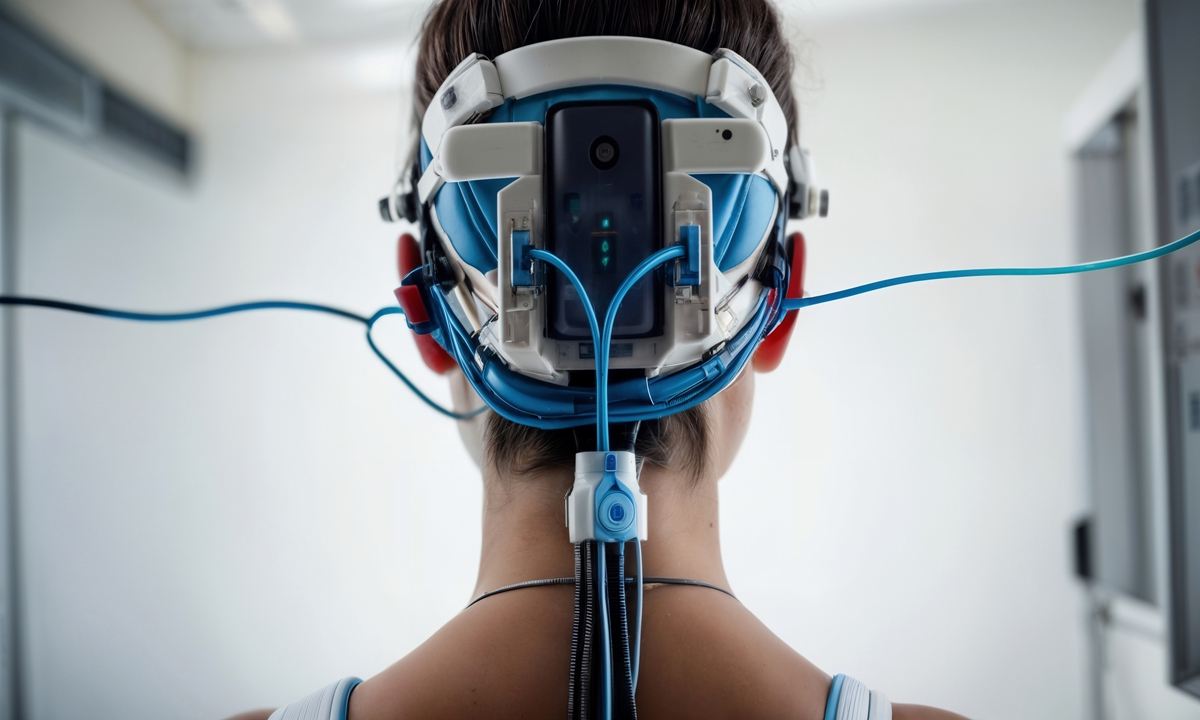
Chinese researchers have developed a multifunctional electrode coating that addresses key challenges in long-term brain-computer interface (BCI) implantation, including signal loss and tissue adhesion, bringing BCI one step closer to clinical application, the Global Times learned from the research team behind the findings on Sunday.
As an emerging field combining neuroscience and artificial intelligence (AI), BCI faces a major challenge of ensuring long-term compatibility between electrodes and brain tissue. Previous clinical trials showed that immune responses could cause implanted electrodes to retract after just three months, severely reducing signal quality and the number of available channels.
This problem stems from chronic inflammation triggered by implants, which creates insulating scar tissue around electrodes and separates them from neurons. Irreversible adhesion between electrodes and brain tissue after long-term implantation also makes device removal risky, potentially causing brain injury during follow-up surgeries.
Experiments showed that flexible neural electrodes coated with this material could operate stably in the brain for more than 300 days and could be safely removed without causing damage. This means the universal coating technology can make electrodes not only operate stably over the long term but can also be safely removed and replaced after aging, paving the way for long-term BCI applications.
Developed by the research team led by Zhang Wei at the Technical Institute of Physics and Chemistry, Chinese Academy of Sciences, associated with Beijing Tiantan Hospital, Shanghai Institute of Microsystem and Information Technology and NeuroXess, a high-tech life science company specializing in BCI technologies, the cationic alternating peptide electrode coating preserves electrode flexibility and conductivity, while offering antibacterial, anti-protein adsorption and immune-rejection-inhibiting functions.
A 300-day animal study showed the coating's effectiveness. Bare electrodes experienced a sharp loss of recording capability after 90 days of implantation and could barely detect neuronal signals after 300 days. In contrast, coated electrodes maintained stable recording channels and consistently captured neural signals above 155 microvolts.
In terms of neural modulation, after 300 days of implantation, conventional electrodes required a current of 100 microamps to induce weak limb responses, while coated electrodes triggered clear movements with only 2 microamps, improving modulation efficiency by 50 times.
Notably, the removal tests highlighted a key advantage of the coating that electrodes no longer form irreversible bonds with brain tissue. In the experiments, the coated electrodes were removed intact, with minimal damage to the surrounding brain tissue, Zhang told the Global Times on Sunday.
。
Current article:http://jz0cl.shuaiseduanguanzhui.bond/gyaiu/20260826/36804.html
Published on:00:00:00


